
We are pleased to provide you the June 2026 Portfolio Update for the Muzinich BDC Income Fund – Active ETF (BDCI or the Fund).
Fund Performance1
Portfolio Commentary
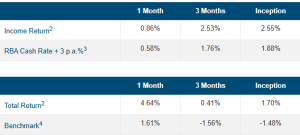
The Fund delivered an income return of 0.86% during the month, compared with the targeted RBA Cash Rate + 3% p.a. return of 0.58%. The Fund declared a monthly distribution of $0.17 per unit, announced on 26 June 2026.
The Fund’s total return of 4.64% for the month also exceeded the 1.61% increase in the S&P BDC Index USD Price Return (unhedged) (Benchmark) over the same period. The Fund’s outperformance was mainly driven by its overweight position in Fidus Investment Corp (FDUS) and its underweight position in Blue Owl Technology Finance (OTF). FDUS reported better-than-expected Q1’26 earnings, a stable NAV, strong dividend coverage with net interest income outpacing dividend and low a non-accrual rate at 0.8%. OTF reported Q1’26 earnings below expectations, with NAV down 4.8% driven by software portfolio mark downs. The shares also faced selling pressure from IPO lockup expiration, and media reports on redemption pressure in Blue Owl private BDCs.
At a macro level, U.S large cap stocks (S&P 500 Index) fell 1.52% in June due to a profit-taking rotation out of mega-cap tech and Artificial Intelligence (AI) infrastructure stocks. This index-level decline masked improving market breadth beneath the surface, as a higher percentage of individual stocks advanced. Under the new Fed Chair Kevin Warsh, the US Federal Reserve maintained a hawkish stance on interest rates policy due to lingering core inflation. This pushed the U.S. Dollar Index to a 13-month high, which has historically acted as a macro headwind for growth equities. Geopolitical risk subsided as the U.S. and Iran entered into mediated peace talks in Qatar. This shift caused crude oil prices to plummet, easing near-term corporate energy cost projections. Despite a complex geopolitical backdrop, the US economy remained largely stable during the period. Muzinich has a favourable outlook on risk assets, as the team sees limited economic damage from the conflict in the Middle East and AI spending continued to drive economical and productivity growth.
The Benchmark rose 1.61%, on expectation of “higher-for-longer” interest rates and stabilising valuation post Q1’26 earnings. The message on interest rates acted as a fundamental tailwind for public BDC earnings models. Because public BDCs primarily issue floating-rate corporate debt, a delayed path to rate cuts preserves their Net Investment Income (NII) margins. Forward-looking investors anticipated stronger-than-expected yield preservation and NII-per-share growth, backing high sector dividend payouts.
While private credit defaults are expected to rise modestly through 2026, Muzinich believes that the asset class is highly unlikely to destabilise the broader market or derail risk assets. To trigger a systemic crisis, these credit pressures would need to severely restrict credit supply to the economy or spark a major solvency event. In Muzinich’s assessment, these are outcomes that current indicators do not support.
The vast majority of private credit is invested through closed-end institutional vehicles, rather than semi-liquid retail structures. While retail funds have attracted headline attention due to redemption pressures, they account for only around 15% of global private credit assets. Institutional financing, which accounts for the lion’s share of the capital in the asset class, is largely invested in funds that do not offer periodic liquidity.
With the Benchmark trading at 0.82x Price-to-Book (P/B) and 12.17% dividend yield, Muzinich sees the risk/reward as attractive. In Muzinich’s view, potential catalysts for improving valuations are:
- Credit stabilisation and lower-than-expected default rates: Current valuations are at levels reached in 2022, when there were similar pressures on valuations due to concern on credit (both with the reported non-accrual rate increasing and expectations of higher defaults on higher rates). Valuation generally improves if earnings start to show stable non-accrual rates or book value. By analysing non-traded BDC monthly NAV movements in April and May 2026, Muzinich believes there are early signs of credit stabilisation and lower default rates emerging.
- Stabilisation of dividends: A number of BDCs reset dividend lower in 1H’26 due to lower base rates and/or credit issues. However, U.S. interest rate expectations have recently undergone a dramatic hawkish shift, moving from widespread anticipation of steady rate cuts in late 2025 to unexpected forecasts of potential rate hikes. Improved dividend yields should underpin valuations.
- Share buybacks: Many BDCs have share buyback programs in place and at current discount level, it is accretive to buy back shares.
Notes: 1. The Fund inception date is 25 March 2026. Fund performance is in AUD and calculated based on net asset value per unit, which is after management fees and expenses and assumes that all distributions are not reinvested in the Fund. Periods greater than 1 year are annualised. 2. Income Return is calculated based on distributions going ex during the period relative to the opening NAV. Price Return represents the change in NAV excluding distributions. Total Return is the sum of Income Return and Price Return and does not assume reinvestment unless otherwise stated. 3. RBA Interbank Overnight Cash Rate Index + 3% p.a. accrued daily. 4. Benchmark for the Fund is S&P BDC Index USD Price Return (unhedged).
DISCLAIMER: AGP Investment Management Limited (AGP IM) (ABN 26 123 611 978, AFSL 312247) is a wholly owned subsidiary of Associate Global Partners Limited (AGP) (ABN 56 080 277 998), a financial institution listed on the ASX (APL). AGP IM is the Responsible Entity of Muzinich BDC Income Fund – Active ETF (ARSN 691 941 401) (the Fund).
This material has been prepared for general information only and does not constitute investment advice or a recommendation. Neither AGP IM, AGP, their related bodies corporate, entities, directors or officers guarantees the performance of, or the timing or amount of repayment of capital or income invested in the Fund or that the Fund will achieve its investment objectives. Past performance is not indicative of future performance.
Any references to ‘We’, ‘Our’, ‘Us’, or the ‘Team’ used in the context of the portfolio commentary, is in reference to Muzinich, as investment manager for the Fund.
Any economic or market forecasts are not guaranteed. Any references to particular securities or sectors are for illustrative purposes only and are as at the date of publication of this material. This is not a recommendation in relation to any named securities or sectors and no warranty or guarantee is provided that the positions will remain within the portfolio of the Fund. Any securities identified and described are for illustrative purposes only and do not represent all of the securities purchased, sold or recommended for client accounts.
The reader should not assume that an investment in the securities identified was or will be profitable. Investors should seek professional investment, financial or other advice to assist the investor determine the individual tolerance to risk and needs to attain a particular return on investment. In no way should the investor rely on information contained in this material. Investors should read the Fund’s Product Disclosure Statement and Target Market Determination in full before making a decision to invest in the Fund. These documents are available at www.associateglobal.com.